
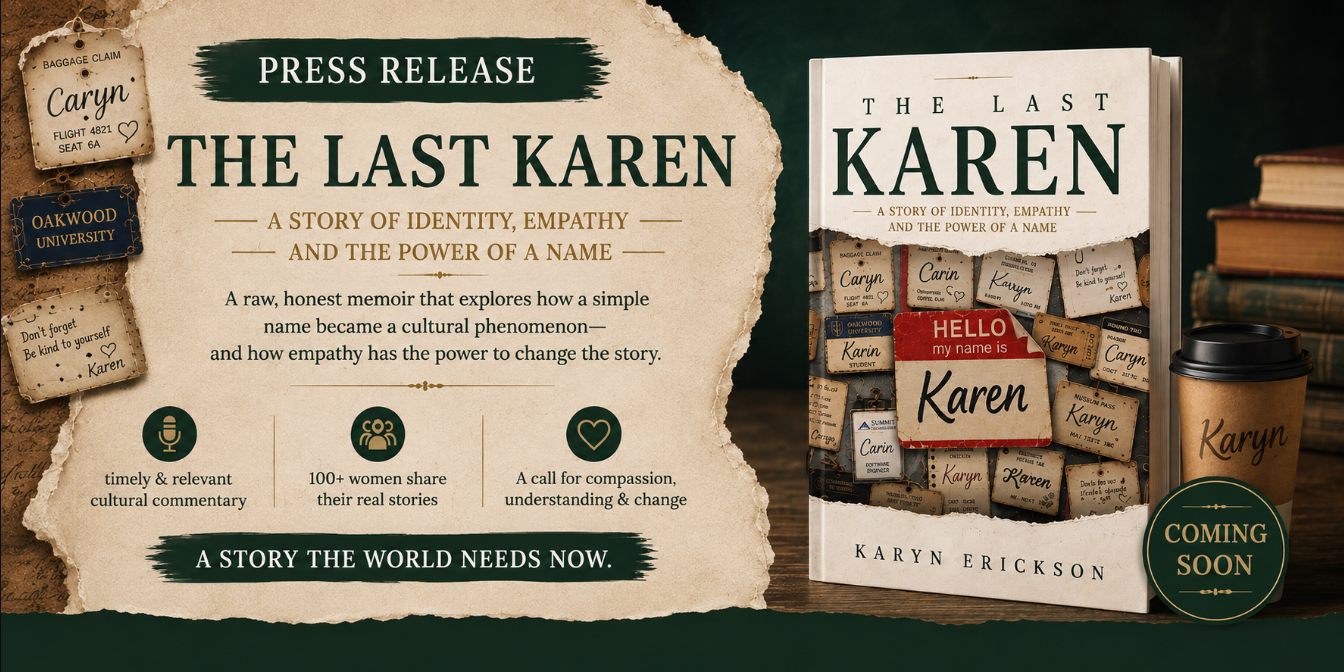
New nonfiction work explores identity, cultural forces, empathy, and what happens when a name becomes a social label
Cedar Park, TX - Aug 18th, 2026: What happens when an ordinary name becomes a cultural stereotype, and the people who carry that name are left to live with the consequences?
Author and researcher Karyn Erickson explores that question in her forthcoming nonfiction book, The Last Karen: A Story of Identity, Empathy and the Power of a Name. Combining personal experience, cultural observation, research, and the firsthand accounts of more than 100 people named Karen, Karyn examines how the name became associated with a recognizable internet caricature and what that shift reveals about identity, language, social behavior, and contemporary culture.
The project began with Karyn's own experiences after the word "Karen" became widely used as a slur. Rather than treating those experiences as an isolated personal grievance, she reached out to people named Karen around the world to understand how the phenomenon had affected their lives, families, professions, and sense of identity. The responses became the foundation for a broader examination of the cultural moment.
At the center of The Last Karen are these personal stories. Participants describe experiences ranging from everyday discomfort to more consequential moments in which their names influenced how others perceived their credibility, behavior, or intentions. Erickson preserves substantial portions of their original voices, recognizing that the book's central conversation depends on hearing from the people who experienced the phenomenon firsthand.
But the book extends beyond individual stories. Erickson examines the social and historical influences surrounding the emergence of the "Karen" phenomenon, which she refers to as "Bubbles." Chapters consider subjects including feminism, #MeToo, Black Lives Matter, COVID, menopause, Christian Nationalism, and the Trump presidency, exploring how these overlapping cultural forces contributed to the environment in which the stereotype gained traction.
The book's approach is intentionally broader than a debate over whether the term is justified. The Last Karen asks what happens when behavior becomes attached to an identity and when a cultural caricature begins to stand in for real people. Its central question is direct: What happens when your identity is diminished, altered, or even villainized without your consent, control, or participation?
The author ultimately points toward compassion rather than simple defense or condemnation. The book's stated goal is to encourage recognition, empathy, forgiveness, and thoughtful conversation while examining the larger social structures that influence how people understand one another. The work also explores possible paths toward broader social change, including discussion of the Equal Rights Amendment and the possibility of replacing competition and division with greater partnership, trust, and equality.
Written for readers interested in history, social change, psychology, women's issues, cultural commentary, human behavior, and contemporary society, The Last Karen offers more than an examination of an internet meme. It presents a cultural record of a moment that continues to shape conversations about identity, gender, race, politics, language, and social responsibility. As the book prepares for publication, Karyn Erickson invites readers to look beyond the stereotype and consider the human beings behind it.
About The Author
Karyn Erickson is an author and researcher whose work focuses on identity, communication, empathy, and contemporary social issues. Through The Last Karen, she encourages readers to question assumptions, engage in meaningful dialogue, and reconsider the narratives that shape modern society.